My sister snatched my phone off the table. “Let’s all hear who the janitor’s been talking to.” She hit speaker. The table burst out laughing. I never reached for it. Then the voice came through “Good evening, Miss Marsh. The board just approved your $14 million acquisition ” News
People think patience is passive. It’s not.
Patience is watching carefully for twenty years, understanding someone so completely that you know, before they do, exactly what they’re going to reach for.
My name is Evelyn Marsh. I go by Evie to people who don’t work for me.
The call was scheduled for 7:00 p.m. I’d known about it for three weeks. I hadn’t told anyone.
Charlotte, 6:15 a.m.
My apartment on the eighteenth floor faced east, which meant the sky went from black to orange to something almost pink before settling into ordinary gray. I’d learned to ignore it.
Beautiful sunrises have a way of slowing you down when there’s still a forty-seven-page due diligence report open on your center screen.
I closed the last tab at 6:12 and sent the signed file to James Harrington, board member. Patient man. Someone with the unusual quality of asking exactly one question per conversation and then waiting for the actual answer.
The confirmation email came back in four minutes. 6:14. Good.
Three screens, two empty coffee cups, one legal pad with six lines of notes I no longer needed. I organized them into the recycling pile with the same care I organize everything. Corners aligned. No excess.
My colleague Marcus calls this a personality trait. I call it a preference for not wasting energy on entropy.
On the corner of the desk, between the legal pad and the phone charger, there was a small painting in a wooden frame. Four inches by five. Watercolor.
Blue Ridge Mountains painted the way they look from a back porch in early November, layered and a little hazy. The kind of painting where the foreground is clearer than the distance.
I’d had it for twenty-two years. I’d never hung it on the wall.
My eyes rested on it for a moment. Maybe two. Then I picked up my car keys.
The blouse situation took longer than it should have. Eight minutes in front of my closet. I know because I checked the time when I started, and checked it again when I finally decided.
Eight minutes is, objectively, the correct amount of time to prepare a pitch deck introduction. It is not, by most standards, the correct amount of time to choose what to wear to your mother’s birthday dinner.
But most people going to their mother’s birthday dinner hadn’t been thinking about it for three weeks.
Here’s the thing about Renee.
My sister has a gift. Not an unusual one. Plenty of people have it. But she’s particularly skilled at reading a room and identifying the fastest route to its center.
Clothes are data. She reads what each choice communicates before the wearer does.
Navy: trying too hard. Something to comment on. Black: hiding something. Also something to comment on. Anything with a pattern: aspirational. Definitely something to comment on.
Gray. Unremarkable gray. The kind that says, I work at an office. I didn’t think much about this. I am not a threat to anyone’s position in this room.
The kind that, if you’re paying attention, says something else entirely.
Most people aren’t paying attention.
I laid the gray blouse across the bed. The thing about dressing for invisibility is that you have to commit to it completely, the same way you commit to any strategy. No hedging. No middle ground.
A gray blouse with interesting earrings is not invisible. It’s trying to be invisible while also being a little interesting. That’s the worst of both worlds.
Plain gray. Hair back. Small gold studs I’d had since law school and never thought about. Exactly what someone who just works at an office would wear.
I zipped the garment bag, started the coffee, and calculated the drive: two hours and twenty minutes on I-26, assuming no construction through Hendersonville.
My phone sat on the kitchen counter. I opened the calendar.
7:00 p.m. Board call. Kellner acquisition. Final approval.
The time read 6:40.
It occurred to me, not for the first time, that what I was doing tonight wasn’t quite what I’d been telling myself it was.
I’d called it an experiment.
Letting the truth be visible, I’d said. In the privacy of my own head, the way you phrase things to yourself when you’re not quite ready to be honest about the motivation. An experiment.
As if I hadn’t spent twenty-two years filing away exactly how Renee operates. As if I didn’t already know what she’d do when she saw a phone on the table with a call scheduled to come in. As if I hadn’t chosen this particular Friday for a reason.
The coffee finished. I poured it into a travel mug. Two sugars. No cream.
I stopped keeping cream in the apartment years ago after discovering that other people’s milk goes bad faster than yours does. One of the minor efficiencies of living alone.
The painting was still on the desk. I left it there. I always left it there.
“I’ve been thinking about this for a while,” I said. To no one.
Then I drove to Asheville.
The mountains start about forty minutes outside Charlotte. Once you clear the suburbs and the distribution centers and the billboards for personal injury lawyers, the road lifts and the trees change.
And somewhere past Tryon, the air pressure in your ears shifts just slightly, like the world is adjusting to you.
I’d driven this stretch enough times that I no longer thought about the scenery. I thought about Renee. Not with anger. I want to be clear about that.
What I felt driving I-26 toward Asheville that Friday morning wasn’t anger. It was something closer to the specific clarity you get after you’ve studied a problem long enough that it stops surprising you.
Renee doesn’t hate me. I’ve never believed that.
What Renee needs is to be the most remarkable person in a room. And for most of our lives, she’s been exactly that.
She’s charming and loud. And she laughs in a way that makes other people want to laugh with her. And she’s genuinely good at certain things: organizing, remembering, hosting, making people feel like the event they’re attending is the most important event in the world.
The problem with being that good at something is what it costs when the room gets crowded.
Every time I’d come home over the past six years, I’d watched her run the same sequence. She’d ask about my job in a tone that suggested she already knew the answer was disappointing. She’d frame the question in a way that allowed for one of two interpretations.
She works somewhere modest, and that’s fine. Or she works somewhere modest and won’t admit it. Either way, the frame stayed.
“Still at that company in Charlotte?”
“What do they do again?”
“You’ve been there six years? No promotion? Or just not the kind with a title change?”
I could map the pattern with eerie precision. It had become almost automatic.
Once, two Thanksgivings ago, I’d mentioned a deal I was working on. Not the details. Just that it was significant. That it had taken eight months.
Renee had nodded and said, “That’s great, Evie.”
And then spent the next four minutes telling the table about Derek’s company winning a county contract.
Her timing was precise. Not cruel, exactly. Just precise.
I’d stopped mentioning things after that.
The road curved through a gap between two ridgelines, and the morning light hit the windshield at an angle that forced me to pull down the visor.
It started before the jobs. Before Charlotte. Before any of this.
It started with a painting.
I was eleven years old. Our school had an art show every November. Nothing elaborate. Just the gym decorated with student work and a folding table with lemonade and those sugar cookies shaped like leaves that parents brought in.
I’d been working on mine for three weeks. Watercolor. The mountains behind our house on a November morning, when the fog comes in low and the ridgeline above it looks like it’s floating.
My teacher, Mrs. Caldwell, had walked past my table twice and not said anything, which meant she was watching.
The show was on a Saturday, 1:00 p.m. to 3:00 p.m. Renee had a piano recital at the same time.
She’d been preparing for it for six months. Not every day, not with any particular discipline, but it was on the calendar, and it was hers.
My parents told me the night before, “We’ll try to make it for part of yours, but Renee has been working so hard on this recital. And you know how she gets nervous. She needs us there.”
My mother said it the way she said most difficult things: quickly, followed immediately by a change of subject, as if speed could reduce impact.
I told her that was fine.
I stood by my painting at 1:15 and watched other families arrive. Some of the parents brought flowers. A few brought balloons.
The gym smelled like wet sneakers and the specific sweetness of cheap frosting, and every folding chair in the second row was occupied by someone’s mother or father or grandmother, and not one of them was mine.
At 2:15, the judges made their rounds. I watched a woman in a green cardigan stop in front of my piece for a long time. She wrote something down. Then she moved on.
At 2:40, they announced the watercolor category.
First place.
The ribbon was red. Thick red ribbon with gold lettering, the kind that felt substantial in your hand, the kind that suggested whoever had made it understood that winning should feel like something.
Mrs. Caldwell handed it to me and said, “I thought so,” which was the kindest thing a teacher had said to me up to that point in my life.
I folded it in half and put it in the inside pocket of my jacket. Not because I was embarrassed. I don’t think it was embarrassment.
I just didn’t know what to do with the happiness of it when there was no one to run toward.
My parents came home at 4:30. Renee had done well. They were taking her out to celebrate. A special dinner. Just the three of us. She deserves it.
“And wasn’t that a nice evening for her?” my mother asked, almost at the door, already halfway toward the car. “The art thing go okay, honey?”
“Fine,” I said. “It went fine.”
Three weeks later, I mentioned, in passing, that I’d won. My mother said, “Oh, really?” in a tone that suggested she was also thinking about something else.
The ribbon stayed in my jacket pocket until the jacket got too small. Then I put it in a shoebox. Then, eventually, I put it somewhere I still know exactly where it is.
That’s where the gray blouse comes from. That’s where most of the decisions I make come from, if I’m being honest. Which I try to be privately, at least, when there’s no one to perform clarity for.
I merged onto the exit ramp for Asheville. The mountains were close now. On all sides. The way they get when you’ve driven into the basin, like they’ve been waiting.
Three weeks ago, when James Harrington’s calendar invite came through, something had occurred to me. Not revenge, exactly. I’d thought about that word and set it aside.
More like an experiment.
I wanted to see what would happen if I stopped going out of my way to hide.
I’d confirmed with my mother that I’d come to dinner. I’d confirmed with James that the 7:00 p.m. slot still worked. I hadn’t changed anything about either plan. The rest was just arithmetic.
I pulled into the driveway at 5:30.
The kitchen light was on. Through the front window I could see the warm yellow of the kitchen. The same yellow it had been for thirty years. And my mother’s shape moving past it.
And Renee’s voice, carrying through the glass before I’d even cut the engine.
She was already holding court.
I took one breath, checked the time, then got out of the car.
My mother came to the door before I reached the porch steps. She must have been watching from the kitchen window. She does that. Has always done that.
The specific vigilance of a woman who learned early that people leave without warning and has spent thirty years monitoring the driveway just in case.
She opened the door, came down the two steps, and hugged me with both arms. The way she hugs when she means it, rather than the way she hugs when there are other people watching.
She smelled like the same lotion she’d used my entire life. Something with lavender in it. I’ve never looked at the label.
“You made it,” she said.
“Happy birthday, Mom.”
She pulled back to look at me. There were new lines around her eyes since the last time. Fine ones. The kind that only show up in certain light, which meant I was standing close enough to see them.
She looked tired in a way that had nothing to do with the time of day.
I filed that away.
“Renee said she wasn’t sure you’d be able to come,” my mother said. “With work.”
“I moved some things around.”
She nodded like that explained something. And maybe it did. Then she held the door open and I went inside.
The house on Kimberly Avenue had been the same since I was seven years old. Same yellow kitchen that had seemed cheerful once and now just seemed stubborn.
Same wood floors that announced every footstep whether you wanted them to or not. Same smell: old wood, and the particular warmth of a house that has been heated and cooled through thirty winters.
I’d always thought you could tell a lot about a family by what they kept and what they let change.
And this house kept everything.
Except the wall by the stairs had been redone at some point. New paint. Lighter. And on it, a large framed photo of Renee and Derek in Hawaii, her in a sundress, him grinning, both of them bronze and effortless.
Below it, two smaller frames: Renee’s daughters at some birthday, pink balloons, frosting on their faces.
And in the corner, almost behind the newel post where you’d have to be looking for it to see it, my law school graduation photo. Four inches by six. In a drugstore frame that had gone slightly yellow at the edges.
I looked at it for exactly as long as it took me to register it. Then I walked into the kitchen.
Renee was already there, opening a bottle of wine and explaining the label to Derek, who was listening with the expression of a man who has listened to many wine explanations and plans to listen to many more.
She looked up when I came in, and her face did the thing it always does: the warmth that arrives a half second too fast, like it was waiting just offstage.
“Evie, you actually came?”
She set down the bottle and hugged me. One arm. Brief.
“I wasn’t sure. Mom said you were swamped.”
“I wasn’t that swamped.”
“You’re always swamped.”
She said it the way you say something that’s supposed to sound like admiration but lands like a diagnosis.
“That’s kind of your thing.”
Derek shook my hand. He’s always been decent to me. Polite in the specific way of someone who has made a private peace with his wife’s family dynamics and chosen non-engagement as his strategy.
I respect it, honestly. It requires discipline.
Dinner was set in the dining room, which Renee had arranged entirely. A tablecloth I didn’t recognize. Small candles. A centerpiece of autumn branches and dried flowers that she’d clearly brought from her own house.
My mother’s dining room, done in Renee’s aesthetic.
I sat at the far end, near the door to the kitchen, and put my phone on the table beside my plate, face down.
Renee’s aunt Harriet and her husband Tom arrived seven minutes later.
Harriet is a woman of sixty-three who comments on everything and means harm by none of it. She operates at a frequency slightly out of sync with any ongoing conversation, contributing observations that are accurate but adjacent to whatever is actually being discussed.
Tom, her husband, has the gift of being comfortable in any setting, which he achieves primarily by sleeping through most of them.
My mother’s friend Lisa rounded out the table. She and my mother have been friends since a church group in 1998, and she has the particular warmth of someone who has watched this family for twenty-five years and knows which subjects to avoid.
The first twenty minutes were fine. Wine poured. Bread passed. My mother’s birthday acknowledged with a small cake Renee had ordered from a bakery in West Asheville.
It had her name on it in cursive.
The candles were lit and we sang, and my mother looked pleased in the slightly overwhelmed way of people who don’t expect to be celebrated.
Then the food came out, and Renee turned to me.
“So, Evie’s still at that company in Charlotte? What’s it called? I always forget.”
“Cassidy Marsh.”
“Right, Cassidy Marsh. Do they keep you busy?”
She was already slicing into her chicken when she asked it, which meant the question wasn’t a question. It was a placeholder. The setup for whatever came next.
“Reasonably,” I said.
“Anyone special these days, or is it still mostly just the work?”
Harriet looked up.
“I heard Charlotte has a Trader Joe’s now. Is that near you, Evie?”
Tom’s head dipped forward briefly, then corrected.
“It’s about ten minutes,” I said to Harriet. Then, to Renee, because she was still looking at me. “Mostly the work.”
Renee nodded with an expression that managed to communicate both sympathy and confirmation simultaneously. The expression said, I thought so. The expression said, That tracks.
She didn’t say either of those things out loud, because she didn’t need to.
She moved on to herself, which was the natural next step.
She was developing a brand presence, she explained to the table. She’d been doing content for two years. Lifestyle, home, intentional living. And she’d recently connected with a woman who ran a collective of small creators and was putting together brand partnership packages.
“There’s real money in it,” she said.
Derek’s eyes did something in the vicinity of the breadbasket.
“Evie, you work in business. You know how it is. The entrepreneur mindset. You just have to be willing to invest in the early stage and trust the process.”
She pointed a fork in my direction.
“You get that more than most people at this table.”
I set down my wine glass.
“Tell me more about the revenue model.”
She told me.
I listened with the part of my mind that processes information and used the other part to run the actual math. 4.2 thousand followers at current engagement rates. One to two brand deals per month at the price point she was describing. Subtract the cost of content production she’d mentioned. Subtract the collective’s fee. Subtract the equipment she’d referenced needing to upgrade.
The number that came out the other end was negative twenty-three percent. Generously.
“Interesting,” I said.
Renee smiled like I’d agreed with her.
Across the table, Derek picked up his wine glass and took a long, quiet sip.
At 6:42, Renee looked at my phone.
I watched her look at it the way I’d watched her look at everything that belonged to me since we were children: casually, with the settled assumption that whatever it was, she was entitled to an opinion about it.
She looked at the dark screen. She looked at the way it was placed. She looked back up at me.
Something behind her eyes recalibrated.
I reached for my water glass and didn’t say anything.
For seventeen minutes, the conversation moved the way conversations at family dinners always move: in circles that look like forward motion.
My mother’s friend Lisa asked about Harriet’s grandchildren. Harriet produced her phone and showed photographs. Tom woke up long enough to agree that the youngest one had grown.
Derek refilled everyone’s wine without being asked, which I noted as the action of a man who has learned that the best way to survive a Renee dinner is to stay useful.
Then Renee said, “Actually, I’ve been curious, Evie. What exactly do you do over there? Like, day to day?”
The table didn’t go quiet. It just paid a different quality of attention.
“Corporate acquisitions,” I said.
Same answer as before.
“Right, but what does that mean practically? Like, what’s a day in your life?”
She tilted her head, genuinely curious-seeming. That was the gift. She could generate the appearance of genuine curiosity on demand, which made it impossible to call the question what it was without sounding defensive.
“We advise companies on transactions,” I said. “Mergers, acquisitions, divestitures.”
“So, you’re like a consultant?”
“An advisor. It’s slightly different.”
“Mmm.”
She considered this.
“So you don’t actually buy the companies. You just help them buy each other?”
“That’s one way to put it.”
“Like a middleman?” she said.
And then, to the table, conversationally:
“Evie’s kind of a middleman for companies that want to buy other companies. Which, that’s actually really interesting. I never knew that’s what you did.”
Back to me.
“Does it pay well? It must be kind of niche.”
There it was. Not a single blow, but three.
You don’t own anything. You work for other people’s deals. And I’m now going to ask about your salary in front of everyone while framing it as a compliment.
“It pays fine,” I said.
“That’s great.”
She reached for the bread.
“Derek’s company just finished a commercial project. What was it, eight hundred thousand total contract? Something like that.”
She looked at him. He nodded once, looking at his plate.
“It’s good when things go well,” she said.
I picked up my fork. I took a bite of chicken that I didn’t taste.
Harriet said something about a property her son-in-law had sold recently, and how the market had been something else these days. Tom asked if anyone wanted more potatoes, then answered himself by passing them to no one in particular.
I want to pause here and tell you something I don’t usually tell people. Not because I’ve decided you deserve it, but because I think it’s relevant to understanding what happened next, what I did, and why, and whether what I did was actually what I’ve been telling myself it was.
Sitting at that table, listening to Renee explain to my mother’s friend that I was essentially a go-between, a functionary, a middleman, a woman who helps more important people do more important things, I felt something I recognized.
Not anger.
Something older than anger.
Something that had the shape of a child standing at a gym door at two in the afternoon, watching every other family arrive, holding a prize that had no one to be given to.
I’d been managing that feeling for twenty-two years. I’d gotten quite good at it.
I’d channeled it into every early morning, every late night, every deal that took longer than it should have, every conference call from a hotel room in a city I didn’t care about. Every moment of sitting across a table from someone who underestimated me and letting them keep doing it until the math told a different story.
And I’d told myself that tonight was different. That this wasn’t about that child at the gym door. That I was simply done hiding. That the plan was just clarity. Visibility. Let the truth be present in the room.
But sitting there, I understood something that I hadn’t let myself understand before.
The plan was precise. I’d chosen a Friday. I’d confirmed a time. I’d put the phone within reach.
These are not the actions of someone who has simply stopped hiding.
These are the actions of someone who has been waiting, with considerable patience, for the right moment to stop being invisible in a way that would be difficult to ignore.
The word for that is not experiment.
I knew what the word for it was.
I checked my watch under the table. 6:51. Nine minutes.
Renee had moved on. She was telling Lisa about a renovation she wanted to do to the back bedroom. Something with shiplap that she’d seen on Instagram.
And Derek was contributing small affirmative sounds at appropriate intervals. And my mother was listening with the particular expression she gets when she is trying to follow a conversation that has moved faster than she wanted it to.
The candles had burned down about a quarter inch.
Outside the window, it was fully dark now, which happens early in October once you get into the mountains.
At 6:54, my phone screen lit briefly and went dark again. The angle of it meant only I could see it, and Renee, who was sitting two seats to my left and had apparently been tracking it for the past twelve minutes.
“Is that a work call?” she asked.
Same warm tone. Same tilted head.
“Scheduled call at seven.”
She laughed. Not unkindly. Just with the slight edge of someone noting a fact they find predictable.
“On a Friday? They really work you that hard?”
“It’s fine.”
“Does your company not have a rule about that? Like evenings and weekends?”
She glanced at Derek.
“Derek’s guys clock out at five. He’s pretty firm about that.”
“Different industry,” I said.
“I guess.”
She looked at the phone again, then back at me.
And the thing that had been shifting behind her eyes for the last fifteen minutes shifted again.
“Must be nice,” she said. “Always needed.”
There was something in that sentence, must be nice, always needed, that didn’t quite line up with the dinner conversation we’d been having.
It was the first thing she’d said all evening that didn’t have a clean vector of dismissal in it. For a moment, I almost thought she meant it.
Then I thought about the graduation photo in the corner behind the newel post, and I thought about middleman, and I thought, no. She’s just recalibrating again.
She saw the scheduled call, and the recalibration produced warmth instead of condescension. Same instrument. Different setting.
I said thank you.
At 6:57, Harriet asked if anyone wanted coffee with dessert, and this produced a small logistical discussion about whether the coffee maker did the single-serve pods or the regular kind.
My mother stood to go check. Lisa went with her. Tom fell asleep again. Derek picked up his phone briefly under the table, then put it back.
Renee reached for the wine bottle.
Her eyes moved to my phone.
The screen had lit again. A brief notification, the text visible for anyone who’d been watching.
Kellner call, 7 p.m.
She looked at it. Then she looked at me. I looked back at her without expression, which is not something I have to practice.
At 6:58, she reached across the table.
Her fingers closed around my phone before I’d shifted in my chair.
She picked it up the same way she’d picked up the red ribbon out of my jacket pocket when I was eleven: casually, without ceremony, the settled confidence of someone who has never been told that certain things aren’t theirs to handle.
She turned it over, looked at the screen, looked at the table, smiled.
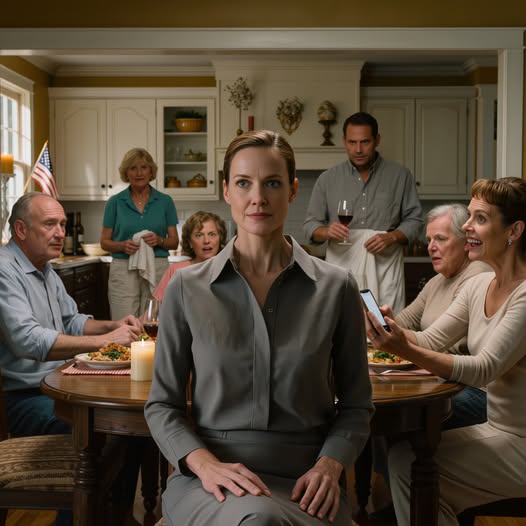
“Let’s all hear who the janitor’s been talking to.”
She hit speaker.
I didn’t reach for it.
The table had been mid-conversation when she picked up the phone. Harriet saying something about a neighbor’s fence. Lisa half-listening. My mother just returning from the kitchen doorway.
And when Renee said, “Let’s all hear who the janitor’s been talking to,” the conversations didn’t stop all at once.
They stopped in sequence.
Harriet first, because she was closest and always alert to the possibility of something more interesting happening. Then Lisa, reading Harriet’s face.
Then my mother, who had turned at the sound of Renee’s voice and was still processing what she’d heard.
The phone sat in Renee’s palm, speaker side up, tilted slightly toward the center of the table.
The people at this table were waiting for something small. A coworker calling about a rescheduled meeting. A food delivery confirmation.
The specific category of call that proves a point about someone being tethered to their job, unable to be fully present even at a family dinner, which is exactly the kind of thing that gets commented on.
That’s what they were waiting for. That’s the frame Renee had built with the word janitor.
Something minor. Something confirmable. Something that would make everyone laugh in the easy way you laugh when someone’s been gently right about someone else.
I sat with my hands in my lap.
At exactly 7:00 p.m., the phone rang.
Renee answered it.
I watched her face while she did the slight performance of casualness, the way she was already composing the expression she’d wear once the call turned out to be nothing.
She held it up a little, presenting it.
A small theater.
Then the voice came through.
“Good evening, Miss Marsh. This is James Harrington calling from the board.”
A pause. The pause of a man consulting notes. Unhurried.
“I wanted to catch you before the weekend. The vote came through about an hour ago. Unanimous. The Kellner acquisition is approved at fourteen point two million. Congratulations.”
Another pause.
Warmer this time.
“This is exactly the kind of deal that puts us on the map. I’ll have the paperwork over to you by morning. Enjoy your evening.”
The call didn’t end dramatically. It didn’t need to.
James Harrington clicked off the way people click off calls efficiently. Without ceremony. Already moving on to whatever was next on his list.
He had no idea he’d just said anything unusual. He’d called a colleague to confirm a good piece of news. That was the entirety of it for him.
For the table, it was something else.
The silence that followed was not the silence of a room that has nothing to say.
I want to be specific about that, because I’ve heard that silence described wrong and it matters.
It wasn’t shock in the theatrical sense. Not gasping. Not the sound of silverware dropped on china.
It was the silence that comes when a room is doing something.
Computing.
Running the same recalculation. Each person at a different speed. All arriving at the same destination.
Harriet was the first one I looked at. Her mouth had closed around whatever she’d been about to say about the neighbor’s fence, and she was staring at the phone in Renee’s hand with an expression I can only describe as genuine.
No performance in it.
Just the face of a woman who has just been handed information that didn’t fit anywhere she’d been planning to put it.
Derek set his fork down. He did it carefully. The way you set something down when you need your hands free to deal with what’s coming next.
He didn’t look at Renee. He looked at the table.
My mother had gone very still in the doorway. She was still holding the dish towel she’d brought from the kitchen.
She looked at me with an expression I hadn’t seen on her face before. Or maybe I had, when I was very young, and had forgotten.
Something that was trying to catch up with itself.
Lisa had turned in her chair slightly away from Renee and toward me, with the instinctive reorientation of someone who has just realized they’ve been facing the wrong direction.
Tom was, improbably, awake.
The particular quality of the silence must have reached wherever he goes when he sleeps through family dinners, because his eyes were open and he was looking at the phone in Renee’s hand with the mildly puzzled expression of someone who has arrived at a movie after the opening scene and is trying to work out the plot.
And Renee?
Renee was still holding the phone.
She hadn’t put it down. I don’t think she’d decided to keep holding it. I think her hand simply hadn’t received the instruction yet.
Her face was doing something I’d never seen it do before, which was nothing.
Not the performed warmth. Not the tilted-head curiosity. Not the quick laugh that redirects a room.
Just stillness.
The face beneath the face, briefly visible.
She looked at the phone. Then at me. Then back at the phone.
I stood up.
I walked around the side of the table. Not quickly. Not slowly. The pace of someone who has somewhere to be and is managing the time accordingly.
I held out my hand.
And after a moment, a moment in which several things happened that I didn’t stay to catalog, Renee put the phone into it.
Not because she wanted to. Because there was nothing else to do.
I looked at her.
Just for a second.
She opened her mouth.
I said, “You wanted the room to see who I am.”
A beat.
“Now they do.”
I walked to the hallway and opened the door to the small room off it. My mother used it for sewing. Or had, before the machine broke and no one replaced it.
I closed the door behind me. Not loudly. Just closed it the way you close a door when there are other people in the house and you’re trying not to disturb them.
I put the phone to my ear.
“Mr. Harrington, I’m sorry for the delay.”
“Not at all,” he said. “Is this a bad time?”
“No,” I said. “It’s a good time. Let’s go over the paperwork.”
We talked for eleven minutes.
He walked me through the approval terms. The timeline for the formal signing. A small amendment to the earn-out clause that the board had discussed in the final meeting.
I made three notes on the back of a grocery receipt I found in my jacket pocket. Same jacket I’d driven down in. Same pocket where I’d been keeping the receipts from the gas station outside Tryon.
It was the only paper I had.
At 7:11, James Harrington said, “Again, congratulations, Evelyn. Genuinely. This was a strong deal.”
“Thank you,” I said. “I’ll look at everything in the morning.”
“Enjoy your evening,” he said again, meaning it this time, and hung up.
I stood in the sewing room for a moment.
The machine was still there in the corner, unplugged, a layer of dust on the flat plate. There was a basket of fabric scraps my mother had been meaning to sort for what looked like several years.
A window faced the side yard, black now with the October dark, reflecting back a small lit room and a woman standing in it in a gray blouse holding a phone.
I didn’t look at my reflection for long.
I put the phone in my pocket, smoothed the front of my jacket, and opened the door.
The dining room was quieter than I’d left it, though not silent. The particular quiet of people who have been talking and stopped when they heard the door.
My mother was back at the table. Lisa had refilled her own water glass. Harriet was looking at a centerpiece branch with great focus, the way you look at something you’ve suddenly found extremely interesting.
Renee was sitting in the same chair. She hadn’t moved. She had both hands around her wine glass, not drinking, just holding it at the base.
Her jaw was set at an angle I recognized from when we were teenagers and she’d lost an argument she hadn’t expected to lose.
Derek looked at me when I came in. He nodded once, very slightly. The way a person nods when they want to communicate that they are aware of what just happened and they have no intention of making it worse.
I sat back down at my end of the table and reached for my fork. The chicken had gone cold, but it was still fine.
The dinner lasted another forty minutes. I know this because I checked the time when I sat back down, and checked it again when my mother started gathering plates, and the number between them was forty-three minutes.
What I can tell you about those forty-three minutes is that the table had a different quality to it than it had before I walked into the sewing room.
Not louder. Not quieter. Just different.
The way a room feels after furniture has been moved, and everyone is still navigating the new arrangement without looking at their feet.
The recalibration took less time than I expected. Forty-five seconds, approximately. I’ve seen slower pivot ratios in quarterly earnings calls.
Derek started it.
He asked, genuinely, I think, what a boutique M&A advisory firm actually does differently from a larger bank.
And I told him in three sentences, and he nodded like the answer made sense to him.
Then Lisa asked how long I’d been at Cassidy Marsh, and I told her six years. And she said that was quite a tenure, which it is.
Then Harriet, who had evidently resolved her feelings about the centerpiece branch, looked at my blouse and said, “You know, I always think it’s nice when people don’t overdress for family things. Very sensible.”
She meant it as a compliment.
I thought, yes. That was exactly the point.
My mother passed the rest of the roast around. Tom ate more potatoes. The conversation moved carefully, the way conversation moves when there is something large and recent in the room that everyone has agreed, without discussion, to step around for now.
And then Renee spoke.
“Evie.”
Her voice had lost the performance quality, which I noticed. She was looking at me with something that wanted to be direct.
She paused. I thought she was waiting for me to fill the pause.
I didn’t.
“I heard you,” I said.
She blinked. That wasn’t the response she’d prepared for.
She’d prepared for it’s fine, or don’t worry about it, or possibly I know, it’s okay, any of which would have allowed her to move on with the understanding restored, the difficulty absorbed, the table returned to normal.
“I didn’t mean it like that,” she said, lower now. “I really didn’t know you did that kind of work. You never say anything.”
“I know.”
“If I’d known, I would’ve—”
“Renee.”
The table had gone quiet again. Or at least quieter. In the way a table goes quiet when the people at it sense that whatever is happening at one end of it should probably be allowed to finish.
I waited until she looked at me.
“I heard you,” I said again. “Both times.”
She closed her mouth.
I turned to my mother.
“Mom, the roast was really good. Did you use the apple cider this time?”
My mother looked at me for a moment, a moment that contained several things she didn’t say, and then she said yes. She’d found a recipe that called for it, and she’d thought it might be worth trying.
And I asked a question about the recipe. And she answered.
And that was how the conversation moved on.
Renee didn’t try a third time.
When dinner finished, people moved in the natural way of post-dinner people. Derek into the living room to find the remote. Lisa helping my mother carry plates. Harriet waking Tom.
The general small dispersal of a family gathering that has reached its natural endpoint slightly ahead of schedule.
I collected the glasses from the table and brought them to the kitchen. And when Lisa offered to finish up, I told her to go sit. I’d handle it.
I wanted the kitchen.
I wanted to be useful and alone at the same time, which is a combination I’ve always known how to arrange.
The kitchen was warm. The smell of the roast had settled into everything. The curtains, probably. The way food smells do when a house is well-heated and the windows have been closed against the October cold.
I filled the sink with hot water, found the dish soap under the cabinet where it had lived since I was seven, and started on the glasses.
I want to be honest about something.
I won.
I want to say that clearly first, because the rest of this is going to be complicated, and I don’t want the complication to obscure the fact that I won.
Renee held that phone up, and the truth came through it, and the room saw exactly what she’d been working for years to keep them from seeing.
The frame she’d built—modest Evie, middleman Evie, always at work because there’s nothing else Evie—fell apart in approximately the same time it took James Harrington to read three sentences.
I stood up. I said one thing. I walked out and took my call and came back and ate cold chicken. She said she was joking, and I told her I heard her, and she sat down.
That’s a win.
I’m aware of that.
But here’s the thing I hadn’t accounted for.
I was standing in my mother’s kitchen at 7:50 on a Friday night, washing glasses that still had wine at the bottom of some of them, and what I felt wasn’t the thing I’d been expecting to feel.
I’d imagined, if I’m honest, if I’d let myself imagine it at all, that it would feel like closing. Like the particular satisfaction of signing the last page of a deal that’s taken a long time. The way the pen moves differently on that page, with more weight somehow.
It didn’t feel like that.
It felt like I’d proven something to a room that would go home tonight and remember the story in the way people remember stories that happened to someone else. With interest. With a certain satisfaction. Possibly with the intention of retelling it.
It felt like I’d put the ribbon on the table in front of everyone. And the eleven-year-old who’d kept it in her jacket pocket for two weeks because there was no one to give it to was still eleven. Still waiting at the gym door. Still not sure whether she wanted anyone to see it.
I’d answered a question tonight. I wasn’t certain it had been the right question.
The screen door opened behind me.
I kept washing.
Footsteps on the wood floor. Unhurried.
Then my mother’s voice, quieter than she’d used at the table all evening, the register she uses when she’s talking to one person instead of a room.
“Evie,” she said. “Come sit with me a minute.”
I turned off the water, dried my hands on the dish towel hanging from the oven handle, same hook, same towel, or a different one in the same place. It didn’t matter.
I turned around.
She was holding two glasses of sweet tea. A glass in each hand. Standing in her kitchen doorway.
“The dishes will be here tomorrow,” she said.
I followed her outside.
The back porch was the part of the house that hadn’t changed at all. Same weathered wood. Same two rocking chairs that had been there since before I could remember.
Same view of the backyard where the sycamore had grown so large in the last decade that its branches reached the roofline.
The October air had gone cold and clean, the way mountain air does after dark. No humidity in it. Just the smell of dead leaves and the faint wood smoke from somewhere down the block.
My mother sat in her chair. I sat in the other one.
She handed me the sweet tea, and I held it and didn’t drink it right away.
Inside, the house sounds. Derek and Tom talking in the living room, the low companionable murmur of a game on TV. Harriet’s voice carrying through the window, telling Lisa something about a recipe.
The sounds of an evening that had resumed itself, was insisting on its own continuation.
Out here, just the dark and the sycamore and the cold.
My mother looked at the yard for a moment. She does this. Sits with a thing before she talks about it. I’ve always found it either the most or least useful quality in a person, depending on how much time I have.
“I didn’t know what you do,” she said. “I didn’t know what you were doing until tonight.”
“I know.”
“You didn’t tell me.”
I held the glass of sweet tea. The cold of it moved through my palm.
“I didn’t think you’d—”
I stopped. Something in the sentence didn’t survive contact with the night air.
I started again.
“No, that’s not fair. I didn’t try.”
She nodded. Very slightly. As if she’d expected something like that and was filing it.
She’s not a woman who performs acceptance. She either accepts or she doesn’t. And when she does, it’s quiet.
“I didn’t ask,” she said.
“No. That’s on me too.”
She said it the way you say something you’ve been deciding to say for a while. Flat and settled. Not looking for argument.
I didn’t say anything for a moment.
The thing about this particular conversation was that I’d imagined versions of it over the years. Not often. And not with any serious belief that it would happen. But occasionally, the way you occasionally imagine things you’ve told yourself you don’t need.
In most of the versions I’d imagined, there was more in it than this. Longer explanations. More accounting. The kind of conversation where things get named that haven’t been named before. Where the years get laid out and examined and attributed.
This was quieter than that.
My mother was not a woman for long explanations. She sat in her chair and said what was true and didn’t elaborate past the point where the truth had been stated.
I found, somewhat to my own surprise, that I preferred it.
“I want to ask you something,” she said. “When you were little, around eleven, you had that painting thing at school. That Saturday. I didn’t come.”
She stopped.
A pause that had weight in it.
“Did you win anything?”
The sycamore moved against the roofline. A small creak of old wood settling.
“First place,” I said. “Watercolor category.”
My mother closed her eyes. Not dramatically. Just closed them. The way you close them when you’re absorbing something and you need a second without visual input.
She held them closed for three or four seconds. Then she opened them and looked at the yard.
“I didn’t know that,” she said.
“I know.”
“You didn’t tell me.”
“You didn’t ask.”
We sat with that.
It was not an accusation. I want to be clear about that. Because it could have been, and wasn’t. It was just the record.
You didn’t ask. I didn’t say. Here we are, twenty-two years later, on your back porch in October, and we’re saying it now.
My mother set down her sweet tea on the armrest of her chair. She folded her hands in her lap, the way she folds them at church. Not devotionally. Just because it’s what her hands do when she’s being still.
“I didn’t see you clearly enough,” she said. “Not just that day. A lot of times. I let Renee take up too much space. And you…”
She made a small gesture with one hand that wasn’t quite a word.
“You were never loud. You never demanded that kind of attention. So I thought you were fine.”
“It wasn’t fine.”
“No,” she said. “No, it wasn’t.”
Another silence.
This one felt different from the others. Not the silence of something unfinished, but the silence of something that has been said and is now in the air between us, visible, taking up the space it needed.
I looked at the yard. The sycamore. The way the branches disappeared into the dark at the top, the lower ones still faintly visible in the light from the kitchen window.
“I didn’t tell you,” I said, “because I thought no one here would really see it.”
I stopped again. Tried it differently.
I’d been told what I was for a long time. And it was easier to build something real somewhere else than to keep trying to show it here and have it reduced, explained down to something smaller.
I paused.
“So I stopped trying here. And then I think I started being angry about it. And then I stopped being angry and just stopped.”
My mother listened.
“Tonight was supposed to be different,” I said. “But I’m not sure it was as different as I thought. I still needed the room to see it. I still needed…”
The sentence didn’t finish cleanly, so I let it stop.
My mother picked up her glass again, looked at the side of my face.
“Did you need me there?” she said. “Because you won anyway. You did that on your own. But did you want me there?”
The question was so specific and so exact that for a moment I just held it.
“You didn’t need me there,” she said. “You got the ribbon anyway. You did that by yourself. But did you want me there?”
The October dark was very still. Down the street, somewhere, a car passed.
“No,” I said.
A beat.
“But I wanted you there.”
My mother set her hand on the armrest of her chair. Not on mine. Just on the armrest. Close.
The gesture of a woman who is not certain how much contact is wanted and is choosing proximity over presumption.
We sat like that for a while.
I don’t know how long. Long enough that my tea went from cold to cool. Long enough that the sound of the TV inside shifted from one program to another. Long enough that the conversation had finished being a conversation and turned into something else.
Not comfortable, exactly. But not the other thing either.
Something in between. Something new.
“You should get back to Charlotte tonight, huh?” she asked eventually.
“I should.”
“It’s a long drive.”
She nodded. Didn’t push.
I stood up. She stood up too, a beat later.
And when I reached for her glass to take inside, she let me have it.
We went back through the screen door into the kitchen, and the sounds of the house came back around us, and the night went back to being the night.
Before I got my jacket from the hook by the door, she put her hand briefly on my shoulder. One second. Just that.
I drove home in the dark.
I drove the first hour without music.
I-26 at night is a different road from I-26 in the morning. The same asphalt. The same curves through the same gaps in the same mountains. But the darkness changes it. Compresses it. Removes the view. Makes the drive feel like a tube you’re moving through rather than a landscape you’re crossing.
The trucks were out. The long-haul kind that own the highway between midnight and 6 a.m. And I fell in behind one for a while and let it set the pace and didn’t think about passing it.
I want to be honest about what I did tonight.
Not the part with the phone. That part I’ve already been honest about, in the way that it’s easy to be honest about things that worked.
I mean the rest of it.
The three weeks of planning. The calendar check. The gray blouse selected with the same framework I’d used to evaluate a target company’s management team. The phone placed where I knew she’d see it. The call confirmed for a time I’d known would land exactly where it needed to land.
I told myself it was an experiment. I’ve been using that word since the beginning.
And it was, in the sense that I genuinely didn’t know what would happen. I didn’t script Renee grabbing the phone. Didn’t arrange the janitor comment. Didn’t know my mother would be standing in the kitchen doorway at exactly that angle when James Harrington’s voice came through.
Those things happened.
I just created the conditions.
But here’s what I didn’t tell myself, and should have.
I had been invisible in that house for twenty-two years. Some of that was Renee building a frame and my family accepting it. And some of it was me, deciding that the safest form of protection was to give them nothing to see.
But fear with a history is still a choice at some point.
And at some point, I’m not sure exactly when, my silence stopped being self-protection and became something closer to punishment. A withdrawal that I maintained long enough that it became permanent.
Long enough that when Renee said, “Let’s hear who the janitor’s been talking to,” she wasn’t entirely making things up.
She was filling a gap I’d left.
I helped build the version of me that everyone at that table believed in tonight. Not with lies. With distance.
There’s a difference.
And I’d been treating them as the same thing.
The truck ahead of me took an exit near Hendersonville, and suddenly the road opened up and I was alone on it, just the white lines coming at me in the headlights, the mountains invisible on both sides.
I turned on the radio, found something low and instrumental that didn’t ask anything of me, and left it on.
At 9:47, my phone buzzed on the passenger seat.
I waited until the next rest area, pulled in, put it in park.
Renee.
Evie. I know I was wrong. I’m sorry. I really didn’t know. If I’d known, I wouldn’t have done that. I’m sorry.
No emoji. No exclamation points.
The sentences had the stripped-down quality of something written and rewritten until only the necessary words were left.
I read it twice.
I put the phone face down on the passenger seat and sat in the rest area parking lot for a few minutes.
A family was at the picnic table near the vending machines. Two kids. A father. Everyone a little road-bleary, stopping somewhere between where they started and where they were going.
One of the kids was chasing a moth around the parking lot light.
The father watched without intervening.
I thought about Renee.
The apology was real. I could tell the difference. I’ve received enough unreal apologies to know what they feel like, the way they’re shaped toward the apologizer’s relief rather than the recipient’s.
This wasn’t that.
This was a woman sitting in her mother’s living room after everyone else had gone, writing something she didn’t want to write because she understood, probably for the first time in a long time, that something had been wrong.
That she had been wrong.
Not the janitor comment specifically, although that too, but the whole structure of it. The years of it.
I was not angry enough to want her to suffer.
I want to say that clearly because it might not be obvious from the outside.
I did not walk into that house tonight with cruelty in mind.
I walked in with a phone and a scheduled call and twenty-two years of patience, and what I wanted was for the room to know who I was.
That’s all I wanted.
I didn’t want Renee to feel what she felt sitting in that chair at 7:15 while the table recalibrated around her. Or maybe I did want it a little.
But not anymore. Not now.
Not sitting in a rest area off I-26, with her apology on my phone and the memory of the porch still close to the surface.
Not now.
What I kept coming back to wasn’t the moment with the phone, but the moment when my mother asked if I’d won the contest, and I said, first place, watercolor category, and she closed her eyes.
I didn’t reply to Renee’s text. Not that night. Not because I decided against it. Because I didn’t have the words yet, and I didn’t want to send the wrong ones.
And the drive still had an hour left in it, and I didn’t want to make a decision about my sister from a rest area parking lot in Hendersonville at ten o’clock on a Friday.
I pulled back onto the highway.
Charlotte announced itself the way it always does. A glow on the horizon first. Then the specific geometry of the skyline coming up against the dark sky, the buildings lit in the particular patchwork of a city that never entirely sleeps.
I took my exit and drove through uptown with almost no traffic, just the traffic lights cycling through their colors for empty intersections, and parked in my building’s garage and took the elevator up to the eighteenth floor.
My apartment was dark.
I turned on the lamp by the desk. Not the overhead. Just the lamp. And set my keys on the hook by the door, the same hook I’d taken them from at 6:43 that morning, a number of hours ago that felt larger than what the clock said.
The three screens were still dark. The legal pad was still in the recycling pile, corners aligned.
And on the corner of the desk, between the legal pad and the phone charger, the small painting in the wooden frame. Four inches by five.
Blue Ridge Mountains in early November.
I sat down in the desk chair and picked it up.
I’d had it for twenty-two years. I’d never hung it on the wall because I’d never decided what to do with it. And in the absence of a decision, it had just stayed on the desk. And eventually, the desk had become where it lived.
I held it now and looked at it. The hazy ridgeline. The way the foreground came in clearer than the distance. The particular quality of watercolor that lets light through the pigment and makes even dark colors carry some brightness in them.
My mother hadn’t known it existed.
I picked up my phone. It was 11:48. Too late to call.
I opened a message instead.
Typed it out. Read it back once.
I’ll come back before Thanksgiving. Just us, if that’s okay. I want to tell you what I do. I want you to know.
I sent it.
Set the phone on the desk.
The Charlotte skyline sat outside the window, patient and indifferent, doing what cities do.
Four minutes later, the phone lit up.
I’ll make the roast. Tell me what day.
I read it twice, looked at the painting, set it back on the desk. Same corner. Same place. Same lamp light on the mountain ridgeline.
But something was different.
Not the painting. The painting was the same.
Some victories require an audience.
Some just require the right person.
I’d known how to be patient for twenty years. I’d watched carefully. Understood thoroughly. Waited for exactly the right moment. I’d known before she did what Renee would reach for.
I just hadn’t applied any of that patience to the question of what I was reaching for.
I turned off the lamp.
The city stayed lit outside the window, the way cities do. Not for anyone in particular. Just because the lights were on and nobody had turned them off.
I thought that tomorrow I would call my mother and we would figure out a date before Thanksgiving.
I thought that was enough for tonight.
Sometimes the silence you choose to protect yourself becomes the silence that erases you. You stop sharing because you’re afraid of being dismissed. And somewhere along the way, that fear stops being a shield and starts being a wall.
You tell yourself you’re protecting something. But what you’re really doing is handing other people the pen and letting them write your story for you.
Evie spent twenty-two years being patient. She watched carefully, waited precisely, and chose exactly the right moment to let the truth speak for itself.
And it worked.
But the moment that actually changed something wasn’t the phone call.
It was a back porch, two glasses of sweet tea, and a mother asking a question she should have asked twenty years earlier.
The lesson isn’t about timing your reveal perfectly. It’s about asking yourself what you’re actually waiting for. And whether the person who needs to see you most might just be one honest conversation away.
Have you ever stayed quiet about something important to protect yourself and realized too late that the silence hurt more than speaking would have?
My name is Juanita Glenn. I am thirty-three years old, and the night my father watched me walk onto the stage of the Worthington Foundation Charity Gala, the color left his face so fast I thought for one wild second he might actually stop breathing. But that moment did not begin in a ballroom. It […]
Three days before I was supposed to walk down the aisle, I found my fiancé replacing my expensive custom artwork with his mother’s cheap family portraits. He smiled brightly and told me she was moving in permanently. He had no idea the wedding was already over in my mind, and that by morning, he would […]
By 8:17 p.m. on New Year’s Eve, I was standing in my father’s dining room in Sacramento with a cold plate of prime rib in one hand and a half-empty glass of grocery-store champagne in the other, while my sister acted like she owned my paycheck. My name is Piper Anderson. I’m thirty-four, a production […]
Have you ever wondered what kind of reason could drive a father to bring his pregnant mistress to his family’s Thanksgiving dinner and command his own daughter to serve her first while his wife of thirty-five years sat there watching? That November evening, when my father, Robert Thompson, CEO of Thompson Holdings, walked Veronica Hayes […]
The morning started like so many other mornings in my quiet neighborhood just outside Seattle, the kind that made a person believe life was still orderly if she just moved carefully enough through it. The sky was pale gray. The air carried that faint wet smell that always came before a proper Washington drizzle, and […]
The folder slid across the Christmas table so softly it almost made no sound at all. Daniel’s mother pushed it with two fingers, right between the dish of candied yams and the basket of dinner rolls, as if she were offering me something polite. Her smile stayed in place, neat and cold. “We think this […]
End of content
No more pages to load
Next page